This is the first in a series of BwB articles examining Ukraine’s financing landscape amid the current conflict and in preparation for long-term recovery: analysing the challenges, the capital gaps, and the financial structures and solutions that are emerging to support reconstruction.
Until 2022, capital flows into Ukraine reflected a balanced combination of foreign direct investment (FDI), participation in international capital markets, and moderate official lending from sovereign partners and international financial institutions.
The onset of war following Russia’s invasion has dramatically altered this composition. Private investment has largely withdrawn, and Ukraine has become increasingly reliant on large-scale official financing.
While this shift has helped sustain fiscal and macroeconomic stability amid the ongoing conflict, it raises important questions around the future shape of Ukraine’s financial landscape and the eventual return of private investment.
Prior to the 2022 invasion, Ukraine was widely regarded as an emerging economy with significant long-term potential. Despite elevated risk and uncertainty dating back to Russia’s annexation of Crimea in 2014, the country was buoyed by its dynamic and innovative private sector, particularly in IT, as well as its highly educated workforce and vast agricultural capacity. While structural challenges remained, the nation was gradually deepening economic integration with global markets, reorienting its economy toward Europe through regulatory alignment and trade reform, and seeking to strengthen its business environment to attract greater foreign investment.
The war with Russia has fundamentally disrupted this trajectory, with widespread destruction of infrastructure, major disruptions to production and trade, and significant displacement of population and loss of labour force capacity – in 2022 alone, Ukraine’s gross domestic product fell by almost 30%. These severe economic dislocations, together with a sharp rise in perceived risk, have significantly weakened investment conditions and curtailed both domestic and foreign capital formation.
Foreign investors step back
Portfolio investment
Portfolio investment refers to foreign investors purchasing or selling Ukrainian financial securities such as government bonds, corporate debt, or equities, without taking controlling stakes. Compared with FDI, these flows are more liquid and more sensitive to changes in market sentiment. As a result, they are widely regarded as a key barometer of private investor confidence and sovereign market access. Sustained net outflows typically signal that a country has effectively lost access to international capital markets and must rely on alternative sources of financing.
In the five years before the COVID-19 pandemic hit in 2020, Ukraine’s portfolio liabilities were on a broadly upward trajectory, averaging US$2.01 billion annually across the period. Even accounting for the adverse impact of COVID-19 during 2020 and 2021, the five-year annual average in the years leading up to the Russian invasion remained robust at US$2.35 billion.* This reflected sustained foreign participation in Ukraine’s sovereign and corporate securities markets, as investor confidence gradually recovered from the shock created by Russia’s 2014 annexation of Crimea.
In 2022, this trend reversed sharply. Portfolio liabilities fell to negative US$1.39 billion, indicating net investment outflows. By 2024, outflows had further declined to negative US$5.93 billion, producing a post-invasion annual average of negative US$2.6 billion between 2022 and 2024.
Figure 1: Ukraine's net portfolio liabilities 2015 - 2024 (US$ bn) Source: BwB; data from National Bank of Ukraine^
This shift from steady inflows to sustained net outflows signals a loss of market access. Rather than issuing securities to foreign investors, Ukraine faced repayments, reduced exposure, and investor withdrawal. In effect, private capital markets closed, increasing the country’s reliance on official external financing.
Foreign direct investment (FDI)
FDI refers to long-term cross-border investment in productive assets such as businesses, infrastructure, or real estate, typically involving a significant degree of influence or control by the investor. It is widely considered one of the most valuable forms of capital inflow because it brings not only financing, but also technology transfer, management expertise, and integration into global supply chains.
From 2017 to 2021, FDI into Ukraine fluctuated (largely reflecting the impact of COVID-19) but remained broadly resilient, averaging US$4.54 billion annually. The impact of Russia’s invasion was a near-total collapse of inflows, with the combination of heightened physical insecurity, economic uncertainty, and political risk rendering large-scale, long-term investment untenable for most foreign investors. FDI for 2022 fell to just US$221 million, representing a 97% reduction from the US$7.95 billion recorded in the previous year.
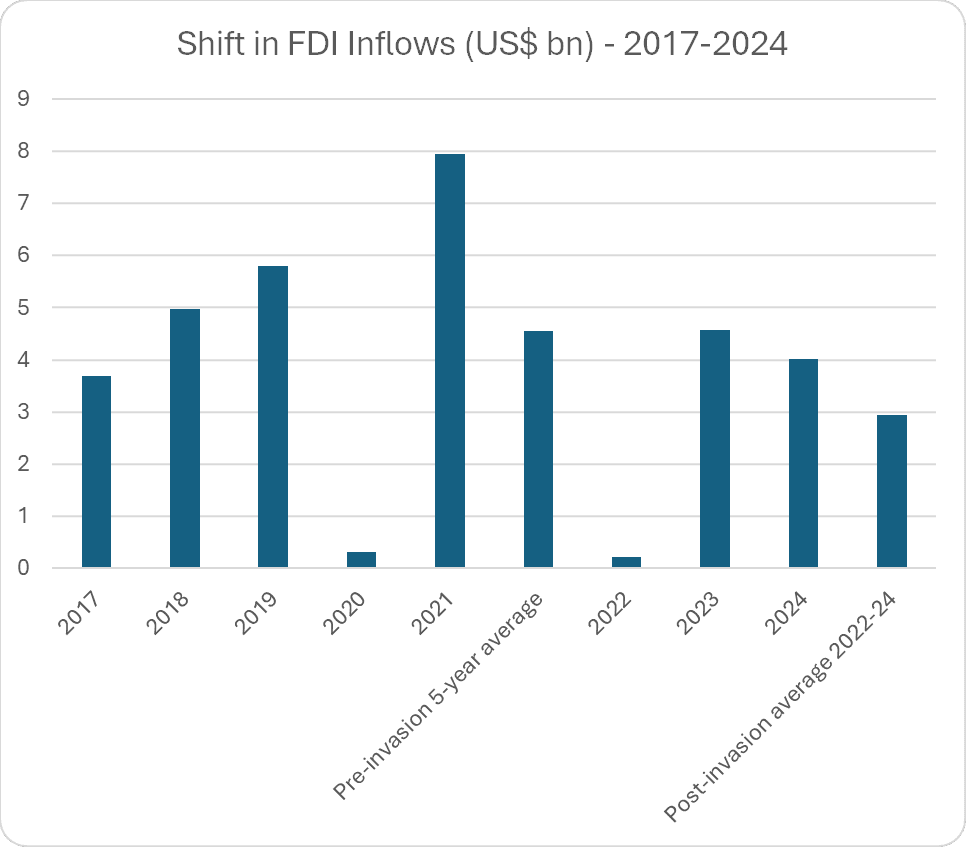
Figure 2: Ukraine FDI inflows 2017 - 2024 (US$ bn) Source: BwB; data from national Bank of Ukraine^
While inflows have partially recovered, they remain below pre-war levels. More importantly, the composition of these flows suggests that investor confidence has not fully returned. Much of the post-invasion investment is reinvested earnings rather than new greenfield equity, with fresh capital inflows remaining limited. Where new investment has occurred, it has often been underpinned by public guarantees and political risk insurance mechanisms provided by international financial institutions and bilateral partners, reflecting continued market caution. This shift in risk allocation is also reflected in the concurrent rise in ‘other investments’ – particularly debt-based and publicly backed instruments.
Sovereigns and multilaterals step in
In macroeconomic classifications, ‘other investments’ refer to cross-border financial flows that are not FDI or portfolio securities. These flows primarily consist of loans, including official and multilateral loans, trade credits, bank deposits, and other forms of debt financing. In Ukraine, this category has become dominated by official external budget support, emergency financing arrangements, and bilateral and multilateral lending since 2022.
Prior to 2022, other investment liabilities were positive but relatively modest. However, However, since the onset of the war this category has expanded dramatically, as Ukraine’s allies stepped in to provide large-scale financial assistance.
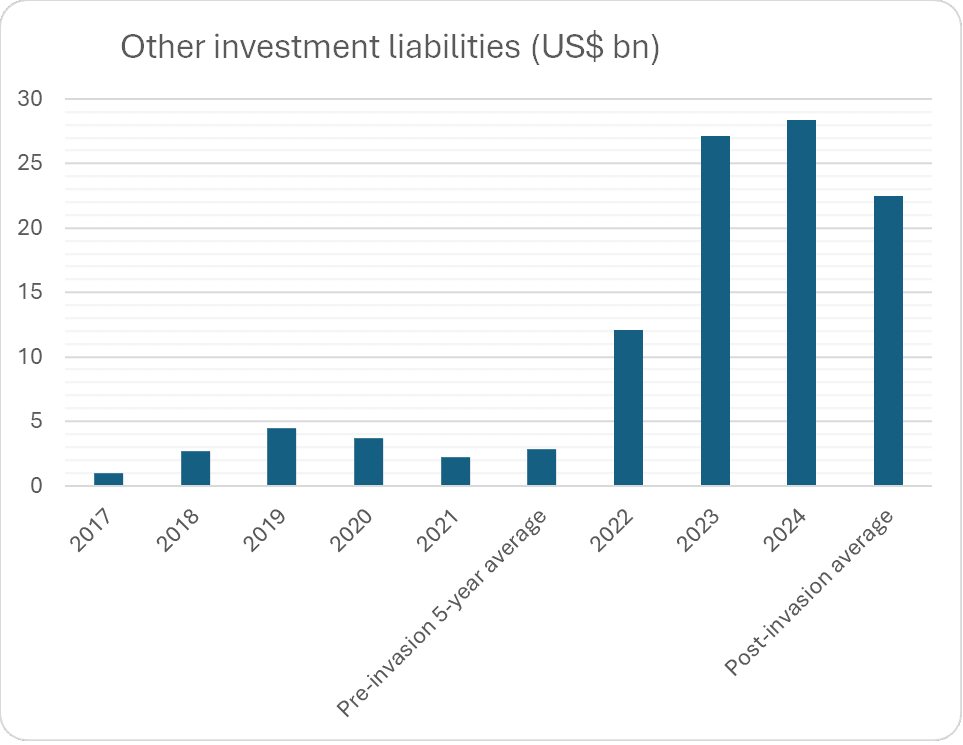
Figure 3: Ukraine other investment liabilities 2017 - 2024 (US$ bn) Source: BwB; data from National Bank of Ukraine^
The sharp expansion of this form of capital flows contrasts with the collapse in FDI and the reversal in portfolio flows. Rather than private capital financing Ukraine’s economy, funding has moved decisively toward government-to-government loans, International Monetary Fund facilities, concessional multilateral lending, emergency trade credits, and grants.
Official financing has been critical in preventing fiscal collapse and sovereign default, stabilising the currency, and sustaining essential government operations during wartime. The significant grant component has mitigated immediate debt pressures. However, it also reflects the near-complete drying up of private capital markets and an increasing reliance on concessional and semi-concessional official debt. Over time, the crucial question will be how Ukraine transitions from a system that is now dominated by official support to a sustainable, market-based financing model capable of supporting reconstruction and long-term economic growth.
The road ahead
The war has dramatically reshaped Ukraine’s external financing landscape. FDI initially collapsed and has yet to fully recover, portfolio flows have reversed into sustained outflows, and official financing has surged to fill the gap. External support has become the dominant pillar of economic stabilisation.
This has been effective in preventing fiscal breakdown and sustaining macroeconomic stability under extreme conditions. However, it is not an optimal long-term model. A financing structure dominated by aid and official loans limits the role of private enterprise, market discipline, and productive capital formation. In turn, this constrains the innovation, competitiveness, and economic dynamism that reconstruction will ultimately require.
The central challenge now is how Ukraine works to rebalance its financing structure: attracting private capital back into an economy still operating under conditions of profound uncertainty. Future articles in this series will examine the key dimensions of this challenge, including:
- What new types of financial instruments could help unlock private capital in post-conflict reconstruction?
- What lessons can Ukraine draw from post-crisis reconstruction efforts elsewhere – and what will require innovative new solutions?
- How should risk be distributed between public and private actors in conflict and post-conflict settings?
- What institutional reforms, risk-sharing mechanisms, and security arrangements could rebuild investor confidence and catalyse the return of market-based capital and private investment?
We welcome your feedback, suggestions, and perspectives as the series develops.
* The COVID-19 pandemic resulted in significant reductions in portfolio investment for the years 2020 and 2021. Additionally, the 2014 Russian annexation of Crimea saw significant drops in portfolio liabilities, which took several years to bounce back. These factors impact the five-year average figures presented here, but do not change the overall narrative.