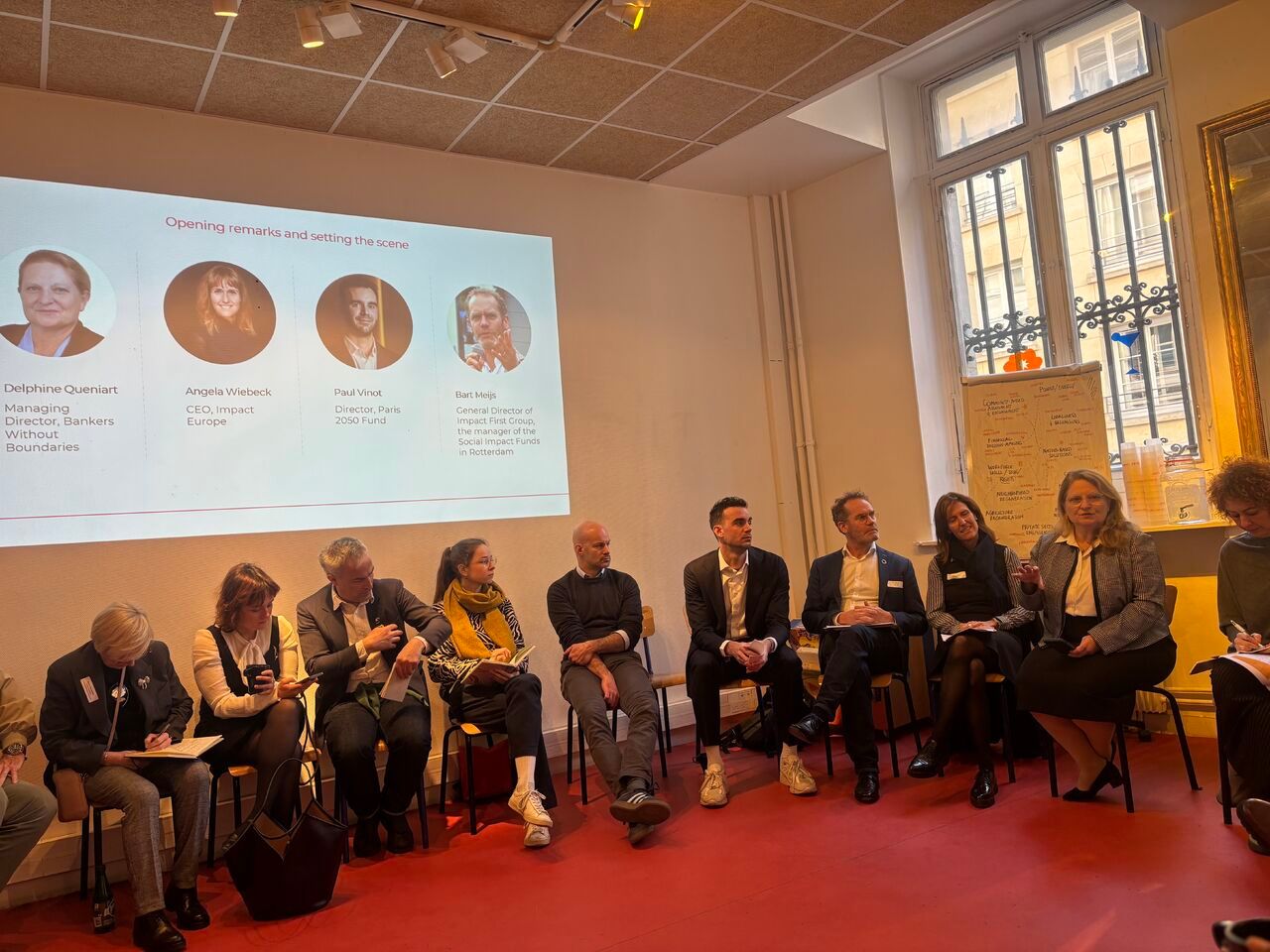
At the Funders Forum on Transitioning Cities – Foundations and Cities Shaping Just Urban Futures, hosted by Philea - Philanthropy Europe Association in Paris recently, a panel of experts came together to explore a critical question:
How do we move beyond grants to finance truly transformative urban transitions?
BwB’s Delphine Queniart was joined by Angela W. (Impact Europe), Bart Meijs (Social Impact Fonds Rotterdam), and Paul Vinot (Paris 2050 Endowment Fund) for a discussion that touched on European case studies where philanthropic funding has been effectively deployed to crowd in capital and scale up impact.
A few valuable takeaways:
It starts with a common vision from the ecosystem, not with individual projects.
In Rotterdam, what began as one city-level fund idea has grown into a broader ecosystem and extended to more cities. By aligning municipalities, foundations, investors and communities – and blending grants, loans, and equity – private capital was mobilised.
The real innovation was governance around a collective objective, not financial engineering.
The bottleneck is alignment.
Cities often lack alignment between public priorities, private expectations, and impact goals. Italian banking foundation Fondazione Cariplo unlocked funding for social housing in Lombardy through an ecosystem approach that multiplied the impact of invested capital by addressing this challenge.
Aligning incentives is key to de-risking projects and crowding in institutional investment.
Philanthropy can catalyse system change.
Laudes Foundation’s Built by Nature programme, which aims to reduce embodied carbon in construction, shows how philanthropy can be used to fund innovation and mobilise co-investment in urban transition.
When aligned with the mission, targeted grants can unlock much larger capital flows.
New financing models are emerging.
Paris is testing a new approach with the Paris 2050 Endowment Fund, deploying privately pre-financed capital to advance projects that the city cannot fund alone, while ensuring public priorities remain central.
With political support and innovative thinking around institutional frameworks, cities can attract philanthropic capital.