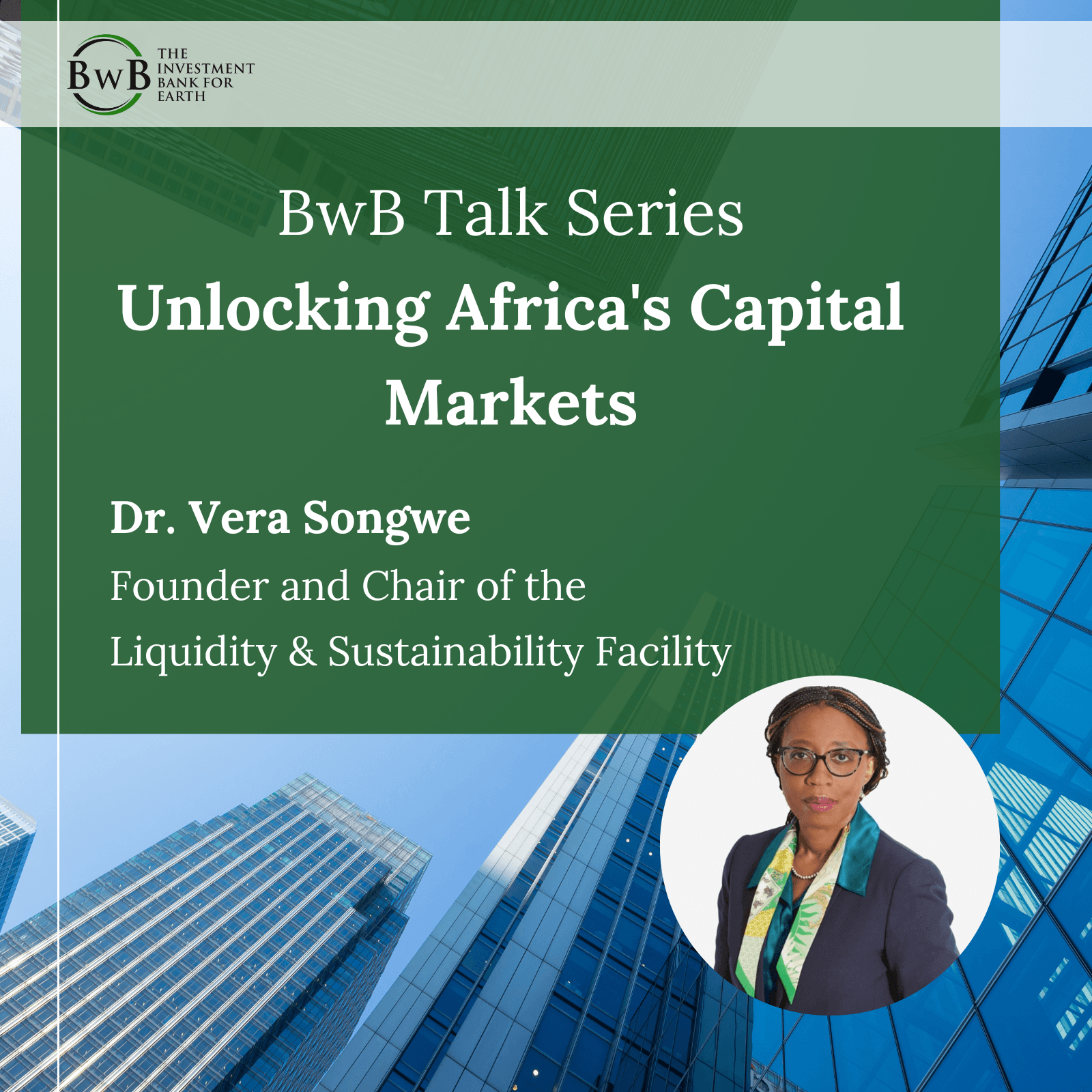
The BwB Talk Series gives our international network the opportunity to engage with and learn from innovative leaders in impact, finance, and the environment. This session offered a rigorous, expert-led analysis of why Africa's capital markets remain constrained and what it will take to change that.
About the speaker
Dr. Vera Songwe is the Founder and Chair of the Liquidity & Sustainability Facility (LSF) and Co-Chair of the Independent High-Level Expert Panel on Climate Finance. She previously served as UN Under-Secretary-General and Executive Secretary of the UN Economic Commission for Africa — the first woman to lead the organisation — and has held senior roles at the World Bank and IFC, where she led major development finance initiatives across Africa. She holds a PhD in mathematical economics from the University of Michigan. As an Advisory Board Member of BwB's Africa Capital Hub, she brings her deep expertise directly to BwB's work mobilising finance across the continent, making her perspective on Africa's capital markets particularly significant for the BwB network.
The real capital problem
Africa does not simply need more capital. It needs the infrastructure to move the capital it already has. According to LSF research, of approximately US$280 billion in African sovereign bonds outstanding, only US$8 billion trades on the secondary market. This illiquidity imposes a direct cost: a liquidity premium that inflates borrowing costs, narrows market access for sovereign issuers, and constrains the resources available for development spending. The necessary instruments, Vera explained, already exist. What is missing is the market infrastructure to deploy them.
What the LSF is building
The LSF is at the forefront of addressing this gap, working alongside international financial institutions and market infrastructure providers. A key initiative is a repo (repurchase agreement) structure between African and international commercial banks, with guarantees enabling transactions in markets that lack investment-grade ratings. In parallel, the LSF is working with Legal & General to launch an exchange-traded fund for African sovereign securities to deepen liquidity, and with BNY Mellon, J.P.Morgan, and Clearstream to standardise African bond issuances. This standardisation work also underpins a separate initiative to develop an Africa Sovereign Bond Index with S&P Dow Jones.
The hidden cost of fragmentation
Settlement infrastructure is a less visible but equally consequential barrier. Africa's 24 central securities depositories largely cannot transact with one another. Settlement costs run between US$20 and US$30 per transaction in several markets, compared with US$1 to US$2 in the United States. The absence of harmonised legal frameworks and issuance hubs means each new jurisdiction requires bespoke legal due diligence – a cost passed directly to investors, and one that effectively narrows the investable universe for external capital. The LSF Trans Africa ICSD (International Central Securities Depository) initiative is focused on standardising these systems and building the interoperability required for seamless cross-border capital flows.
Regulation, ratings, and what needs to change
Three regulatory dynamics constrain African capital markets. Basel High-Quality Liquid Assets and liquidity coverage ratio rules currently over-penalise African sovereign paper, creating incentives to hold it rather than trade it. Domestic asset allocation guidelines in several sub-Saharan markets compound the problem, limiting portfolio flexibility and the scope for green and development-oriented investment. On ratings, Vera pointed to the value of local rating agencies in helping governments engage constructively with major agencies ahead of public assessments as well as ongoing discussions with major agencies on Africa-specific criteria could give sovereign issuers greater influence over their own cost of capital.
We extend our sincere gratitude to Vera for sharing her expertise and time with the BwB network and Africa Capital Hub community.
To learn more about the BwB Talk Series or partner with us on future sessions, follow BwB on LinkedIn or reach out at [email protected].